
Three tiers of Agentic AI — and why most enterprises are building in the wrong one.
The Spectrum Nobody Wants to Admit
There is a version of the enterprise that most technology leaders can describe but none have yet built. One where business outcomes are not just measured but pursued — where systems don’t wait for instructions but act within boundaries, learn from consequences, and coordinate across functions without a human scheduler sitting in the middle. Where the distance between a strategic intent and its operational execution is governed by architecture, not by headcount. That enterprise — the autonomous enterprise — is not a vendor promise or a consulting abstraction. It is a genuine architectural destination. And the path to it runs directly through one of the most contested and least understood concepts in technology today: Agentic AI.
The problem is not that enterprises aren’t moving toward it. Most are. The problem is that the majority believe they are further along that path than they actually are — and that belief is being actively manufactured by a discourse that profits from imprecision. McKinsey’s research tells us that only one in six AI initiatives reaches enterprise-wide scale. The reason is rarely the technology. It is almost always the architecture beneath it.
“The reason is rarely the technology. It is almost always the architecture beneath it.”
Agentic AI has become one of those terms that expands to fill whatever space you give it. At one end, a founder on LinkedIn demonstrates how they’ve connected five SaaS tools with a logic layer and calls it an autonomous agent. At the other, a handful of organizations are quietly beginning to design systems where agents carry persistent memory, operate under governed decision authority, and are held accountable to measurable business outcomes. Both are described using the same vocabulary. They are not remotely the same thing.
This matters because vocabulary shapes investment decisions. Enterprises that believe they have implemented agentic AI — when what they have implemented is sophisticated orchestration — are not just mis-categorizing a technology choice. They are building on a foundation that will not scale — and they will discover that only after the cost has compounded beyond the point of easy correction.
What is missing from the current discourse is not enthusiasm — there is plenty of that. What is missing is a clear-eyed map of the terrain: what actually exists today, what it can and cannot do, and what genuine enterprise-grade agentic architecture looks like when it is designed with the autonomous enterprise as the actual target. That is what this piece attempts to provide.
— — —
All Agents Are Not Equal
The word ‘Agentic’ is doing too much work. It is being applied simultaneously to a sales rep’s personal outreach automation, a domain-specific customer service platform deployed across a contact center, and a cross-functional execution layer that coordinates procurement, finance, and operations under a unified governance model. These are not variations of the same thing. They are categorically different in architecture, in organizational implication, and in their proximity to the autonomous enterprise as a destination.
At the center of that difference sits a single defining question — one that cuts through the noise of vendor claims, implementation labels, and technology enthusiasm more cleanly than any other: does the system execute consequential actions within defined boundaries on behalf of the organization, or does it stop at insight, surface a recommendation, and wait?
That question is the autonomy test. And it matters more than it might first appear, because the enterprise technology industry has spent two decades building extraordinarily capable systems that stop just short of it. Analytics platforms that surface the right insight. Decision-support tools that model the right outcome. Dashboards that present the right data to the right person at the right moment. All of them valuable. None of them autonomous. The gap between a system that recommends and a system that acts — within governed boundaries, accountable to measurable outcomes — is not an incremental improvement. It is an architectural rethinking of what enterprise software is for.
“The gap between a system that recommends and a system that acts is not an incremental improvement. It is an architectural rethinking of what enterprise software is for.”
This is the autonomy gap. And it exists not just between the enterprise of today and the autonomous enterprise of the future, but within the current agentic AI landscape itself — between implementations that are genuinely closing that gap and those that are widening it while claiming otherwise.
To navigate this terrain usefully, it helps to stop treating agentic AI as a binary condition — present or absent, implemented or not — and start treating it as a spectrum with meaningfully distinct tiers. Not a maturity model in the conventional sense, where an organization receives a single score and a set of recommendations. The more useful unit of analysis is the system, the workflow, the function. An enterprise does not have a single agentic readiness level. Its systems do. And those systems sit at very different points on the autonomy spectrum, often within the same organization, sometimes within the same department.
Three architectural questions determine where any implementation actually sits on that spectrum — and therefore how honestly it answers the autonomy test. Does the system carry persistent memory across interactions and decisions, or does each invocation begin from zero? Is execution governed by policy and bound to measurable business outcomes, or does it operate without accountability to organizational intent? And is the system embedded in enterprise decision flows, or does it sit as an orchestration layer on top of tools that were never designed to work together as a unified intelligence?
The answers place any implementation — however it is labelled — into one of three tiers. And the distance between them is not a matter of degree. It is a matter of kind.
DIAGRAM: The Autonomy Gap — Three-Tier Spectrum
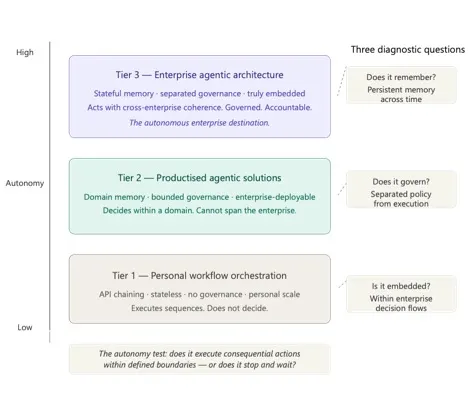
Tier One: The Automation That Wore an Agent’s Clothes
Open any professional network on any given day and you will find them. Posts announcing that the author has ‘built an AI agent’ that handles their entire outbound sales pipeline. Threads walking through how a solopreneur automated their content calendar, their invoice processing, their customer onboarding — all in an afternoon, all using tools anyone can access, all described in the language of agentic AI. The enthusiasm is genuine. The results, at the individual level, are often real. The label is almost always wrong.
What is actually being described in the overwhelming majority of these implementations is orchestration. A sequence of API calls to existing SaaS tools — Apollo for prospecting, Clay for enrichment, Instantly for outreach, Notion for logging — connected by conditional logic and a language model that formats inputs and interprets outputs between steps. The tools do the work they were always designed to do. The logic layer routes between them. The language model provides the connective tissue. It is, in engineering terms, a sophisticated workflow automation. It is not, in any architecturally meaningful sense, an agent.
This is not a trivial distinction. An orchestration layer has no memory of what happened yesterday, last week, or in the last transaction with the same customer — unless memory is explicitly engineered into each step, which it rarely is. It has no understanding of organizational intent — it executes the sequence it was given, regardless of whether that sequence still serves the outcome it was designed for. It has no governance layer that asks whether the action it is about to take is appropriate, permissioned, or aligned with policy. And critically, it fails in ways that are invisible — not loudly, with error messages, but silently, with the wrong email sent to the wrong prospect, the wrong data passed to the wrong system, the wrong recommendation surfaced to someone who acted on it.
At the personal workflow level, these limitations are manageable. One person built it, one person operates it, one person notices when it breaks. The blast radius of failure is bounded. The cognitive overhead of maintenance is absorbed by the person who benefits from it. This is genuinely useful technology deployed at an appropriate scale.
The problem begins when this model is proposed — or mistaken — for enterprise deployment. An enterprise does not have one person’s workflow. It has hundreds of interdependent workflows, each touching shared data, shared systems, shared customers, shared accountability structures. The orchestration layer that works elegantly for one sales rep’s outreach sequence becomes a governance nightmare when three hundred sales reps are running variants of it simultaneously, each pulling from the same CRM, each writing back to the same records, none of them operating under a unified policy about what the system is authorized to do. The personal automation that saved four hours a week becomes the enterprise liability that corrupted the pipeline data nobody noticed for six weeks.
None of this is an argument against Tier 1 existing. Personal workflow automation is a legitimate and growing category, and the tools that enable it are genuinely impressive. What it disqualifies is the label. Calling a personal orchestration layer an enterprise agentic AI implementation is not a harmless exaggeration. It shapes how leadership understands their AI posture, how boards are briefed on AI progress, and how investment decisions are made about what to build next. Organizations that believe they are operating agentic AI because their employees have built clever personal automations are not just wrong about a category. They are wrong about where they stand on the path to the autonomous enterprise — and that misreading has a cost that compounds quietly until it doesn’t.
It works. But what you call it determines what you build next.
— — —
Tier Two: Genuine Intelligence, Bounded by Design
Tier 2 exists because Tier 1 exposed a real need without meeting it. Enterprises watched personal workflow automation proliferate across their organizations — in sales, in legal, in finance, in operations — and recognized two things simultaneously: that the underlying idea was sound, and that the execution was ungovernable at scale. Tier 2 is the market’s answer to that recognition. It is, for the most part, a genuine and serious answer.
The productized agentic platforms that define this tier — Salesforce Agentforce, Microsoft Copilot Studio, and a growing ecosystem of vertical specialists in legal, finance, procurement, and customer operations — are not orchestration layers dressed in agentic clothing. They are purpose-built systems with real agent logic, domain-specific memory, and governance structures designed for organizational deployment. They can be configured, permissioned, audited. They operate within defined boundaries. They deliver measurable value within their domains, often quickly and at meaningful scale. This is not a trivial achievement, and it deserves to be recognized as such before the structural critique that follows.
Because there is a structural critique.
Every Tier 2 platform is, by architectural necessity, bounded. It is designed to solve a specific class of problems within a specific operational context — customer service, sales execution, contract review, financial reconciliation. That boundedness is not a flaw in the design. It is the design. It is what makes these platforms deployable, governable, and commercially viable. A platform that tries to span the entire enterprise from the outset is a platform that ships nothing fast enough to matter.
But boundedness at the platform level becomes fragmentation at the enterprise level. And fragmentation is a problem the enterprise technology industry has encountered before, in a context that should give every CTO pause.
Cast your mind back to the early 2000s. The promise of SaaS was liberation — from monolithic ERP systems, from expensive on-premise infrastructure, from IT departments that took eighteen months to deliver a new capability. The promise was largely kept. Best-in-class point solutions proliferated, each solving its domain problem with focus and speed that enterprise software had never before achieved. Salesforce owned the CRM. Workday owned HR. ServiceNow owned IT operations. Dozens of specialists filled every gap in between.
And then, quietly, a new problem emerged. Data fragmented across systems that were never designed to share it. Workflows that crossed functional boundaries required human coordinators to carry context from one platform to the next. Integration layers grew into integration nightmares. The average enterprise today runs hundreds of SaaS applications. A significant portion of its IT budget goes not to new capability but to connecting the capability it already has.
The question worth sitting with — and it is deliberately posed as a question, not because the direction is unclear, but because the enterprise technology industry deserves the chance to answer it honestly before the verdict arrives — is whether the current generation of domain-specific agentic platforms is laying the foundation for a similar outcome at a higher layer of abstraction. Not data fragmentation this time, but intelligence fragmentation. Each platform carrying its own bounded memory, its own governance model, its own definition of what a good outcome looks like. Each solving its domain problem with genuine competence. None of them able to coordinate across the enterprise as a unified intelligence.
If the autonomous enterprise requires systems that act with coherence across functions — procurement talking to finance talking to operations talking to customer commitments, in real time, under a single governance framework — then a patchwork of domain-specific agentic platforms may get enterprises further than Tier 1, but it will not get them to the destination. It will get them to a more sophisticated version of the integration problem they already have.
That may be an acceptable trade-off for many organizations in the near term. Tier 2 delivers real value today, and real value today is not nothing. But it is worth being clear-eyed about what is being deferred — and what the architectural cost of that deferral might eventually look like.
— — —
Tier Three: Architecture for the Autonomous Enterprise
Tier 3 does not yet exist at scale. That is an uncomfortable thing to say at the start of a section that argues for its necessity — but intellectual honesty demands it. There are organizations experimenting at its edges. There are teams building toward it with genuine rigor. There are architectural patterns emerging that point in its direction. But the autonomous enterprise — operating at full Tier 3 depth, across functions, under unified governance, with agents executing consequential decisions within defined boundaries — is still more destination than reality for the overwhelming majority of organizations on the planet. Naming that honestly is not defeatism. It is the only useful starting point for a serious conversation about how to get there.
What makes Tier 3 categorically different from what came before it is not the sophistication of the models it runs, nor the number of agents it deploys, nor the breadth of functions it touches. It is three architectural commitments that most current implementations have not made — and that cannot be retrofitted onto an orchestration layer or a collection of domain platforms once the foundation has been poured.
The first is that agents are stateful systems, not stateless processes. In Tier 1 and much of Tier 2, each agent invocation begins from zero. The system receives an input, executes a task, returns an output, and discards the context. It has no memory of the customer it spoke to yesterday, the decision it made last week, or the outcome that followed from that decision. This is not a limitation of the underlying models — it is an architectural choice, made because stateless systems are simpler to build, cheaper to run, and easier to reason about at the component level. The cost of that choice is paid at the enterprise level, where consequential decisions require accumulated context, where trust is built through demonstrated consistency over time, and where the gap between what an agent knew and what it needed to know is often where failures originate.
A Tier 3 architecture treats memory not as a byproduct of agent operation but as a managed enterprise asset — versioned, governed, auditable, and deliberately designed to persist across interactions, across agents, and across time. Different types of memory serve different purposes: the immediate context of an active task, the accumulated history of a customer relationship, the institutional knowledge of how this class of problem has been handled before, the policy constraints that bound what any agent in the system is authorized to do. Managing that memory architecture is not a technical afterthought. It is one of the core engineering challenges of building toward the autonomous enterprise — and one of the clearest indicators of whether an organization is genuinely operating in Tier 3 or approximating it.
The second commitment is the separation of governance from execution. In most current agentic implementations, governance is either absent or embedded — rules baked into the agent’s prompt, guardrails hard-coded into the workflow, human approval gates inserted at points where the consequences of error are too visible to ignore. This works, up to a point. But it does not scale, because it conflates two things that need to be independently managed: the policy that defines what the system is authorized to do, and the execution layer that does it. When governance is embedded in execution, changing the policy means rebuilding the agent. Auditing a decision means reverse-engineering a prompt. Demonstrating compliance means reconstructing a workflow that was never designed to be reconstructed.
A Tier 3 architecture separates these concerns deliberately. Governance sits in its own layer — a control plane that defines authority boundaries, monitors execution against policy, and maintains an auditable record of every consequential decision the system has made and why. The execution layer operates within those boundaries, with the freedom to act quickly and the constraint of acting accountably. This separation is what makes a Tier 3 system governable at enterprise scale — not just by the team that built it, but by the compliance function, the risk function, and ultimately the board that is accountable for what the organization does in the world.
The third commitment is embeddedness — agents that are designed from the outset to operate within the enterprise’s actual data environment, not on top of a sanitized subset of it. This is where the entropy of enterprise data — the structural, semantic, and contextual inconsistencies that accumulate silently across systems and that the author has examined in detail elsewhere — becomes directly relevant to the agentic agenda. An agent operating on inconsistent, poorly structured, or contextually ambiguous data does not fail loudly. It fails silently — returning plausible-sounding outputs that are subtly wrong, making decisions that seem reasonable but are built on a corrupted foundation. Embeddedness means confronting that reality directly: assessing the data environment system by system, function by function, before agents are given consequential authority within it.
These three commitments — stateful memory, separated governance, genuine embeddedness — are not a checklist to be completed before Tier 3 begins. They are architectural principles to be built toward incrementally, function by function, workflow by workflow, as the enterprise develops both the technical foundation and the organizational confidence to extend autonomous authority further. The autonomous enterprise is not a destination reached in a single transformation program. It is a direction pursued through deliberate, compounding architectural choices — each one expanding the boundary of what can be trusted to execute without a human in the loop.
That architecture — what it looks like in full, how it is structured, how it is governed, and how an enterprise navigates toward it from wherever it currently stands — is the subject of a subsequent piece. What can be said here is that the design principles are becoming clear, even as the implementation playbook continues to evolve.
“Autonomy is not a feature you deploy. It is a property of the architecture you build.”
— — —
The Question Is Not Whether, But Where
The autonomous enterprise is not a binary outcome. You do not wake up one morning having achieved it, any more than you wake up having closed a gap you never measured. It is the result of compounding architectural decisions made over time, each one either narrowing the distance between strategic intent and autonomous execution or quietly widening it while the organization looks the other way.
Most enterprises are doing both simultaneously. Somewhere in the organization, a team is building genuine architectural foundations — investing in data quality, designing governance structures, thinking carefully about what it means to extend consequential authority to a system that will act without being asked. Somewhere else in the same organization, a dozen personal automations are being called enterprise agentic AI in the board presentation next Thursday. Both are true at once. The autonomy gap is not a clean line between organizations that have it and organizations that don’t. It runs through the middle of most enterprises, system by system, function by function, decision by decision.
“The autonomy gap is not a clean line between organizations that have it and the ones that don’t. It runs through the middle of most enterprises.”
Which is why the right question is not whether your organization is doing agentic AI. At this point, almost every organization can answer yes to that — and almost none of them mean the same thing by it. The right question is more precise, and considerably more uncomfortable: which tier are you actually operating in, system by system — and do the architectural choices you are making today put you on a credible path toward the one that matters?
Answering that question honestly requires looking at each system, each workflow, each agent deployment not through the lens of the label it carries but through the lens of the three architectural realities that determine where it actually sits. Does it remember? Does it govern? Is it genuinely embedded in the decision fabric of the enterprise — or is it sitting on top of it, doing useful work, but work that stops well short of autonomous execution?
The enterprises that answer those questions clearly — even when the answers are unflattering — are the ones building on solid ground. The ones that don’t will find themselves, sooner than they expect, with a sophisticated collection of Tier 1 automations and Tier 2 platforms that do not talk to each other, do not share memory or governance, and have collectively consumed the transformation budget that was supposed to fund the architecture that actually matters.
The architectural blueprint for what Tier 3 actually looks like in full — how its components are structured, how memory is managed as an enterprise asset, how governance is separated from execution at scale, and how an organization navigates toward it from wherever it currently stands — is the subject of the next piece in this series. That architecture has a name, and a design, and a set of principles that are becoming increasingly clear even as the implementation playbook continues to evolve. What can be said here is that the path exists. But it begins with an honest answer to a question most organizations are not yet asking with enough precision.
Not: are we doing agentic AI?
But: where, exactly, are we — and is that where we think we are?
— — —
About the Author
Debiprasad Banerjee is the CEO of Acxelin Agentix, an AI-first company helping enterprises reimagine customer engagement through intelligent automation and digital experiences. Through his writing, he shares practical insights on AI, innovation, and the future of business. Explore more articles from the Acxelin Agentix team for expert perspectives on enterprise AI and digital transformation.