
The Demo Is Not the Product – and What Enterprise AI Delivery Actually Requires
There is a story circulating in boardrooms right now, and it goes something like this. A customer call is recorded. The transcript is fed to a large language model. A product requirements document emerges. That document is passed to a design tool. Screens appear. The screens and the requirements are handed to a code generation tool. A working application is produced. The entire sequence takes less than a day. The customer can see it, click through it, and confirm it works.
This story is being told with genuine conviction. In some circles it is being told as evidence that software development, as a discipline, has been fundamentally disrupted — that the distance between an idea and a working product has collapsed, and enterprises that once needed months and engineering teams to build functional applications can now produce them in hours with a well-constructed prompt.
The story is not entirely false. That is precisely what makes it dangerous.
Every step in that sequence actually works — under the right conditions, at the right scale, for the right definition of “working.” A transcript can produce a PRD. A PRD can produce UX screens. Screens and requirements can produce code that runs, that responds to clicks, that looks, to a non-technical eye, like a finished product. The demo is real. The application launches. The customer is impressed.
What happens next is where the story quietly ends and reality begins.
The industry has a name for this phenomenon. It is called vibe coding — the practice of building software through natural language prompts, accepting generated output, and iterating conversationally without deeply reviewing what has actually been produced underneath. Enterprise adoption of AI coding tools grew 340% from 2024 to early 2026. 93% of C-suite executives are now concerned about the proliferation of ungoverned applications built with these tools. The speed is real. The concern is also real. And the gap between them is exactly where enterprise software goes to fail.
But the one-prompt illusion does not stop at the boardroom. It travels. It gets absorbed by the executives who sit in those boardrooms, flows into how their commercial teams construct deals, and lands — already signed and committed — on the desks of the engineering teams expected to deliver them. GTM teams, responding rationally to what leadership believes is possible, are returning from customer conversations with timelines that reflect the demo, not the deployment. A few weeks to build. A month to productionize. Then we are done. The customer has been told this is reasonable because the people who told them genuinely believe it is. The contract reflects it. The delivery expectation is set.
What follows is one of two outcomes. Either the engineering team pushes back and is told they do not understand how to use modern AI tools — the very tools that were supposed to make this possible. Or they do not push back, absorb the pressure, and attempt to deliver under conditions that make quality, security, and architectural integrity impossible to maintain. In either case, the damage is done before a single line of production code is written. The myth has been commercialized. And commercialized myths are significantly harder to correct than abstract ones, because unwinding them requires not just a conversation about technology but a renegotiation of a business commitment.
The one-prompt illusion is not a technology problem. It is a perception problem with technology consequences — and a commercial problem with delivery consequences. And it is being sustained, in most organizations, by a fundamental confusion between two things that look identical from the outside and are categorically different in every way that matters: a prototype, and a product.
The Prototype-Product Gap
The word “prototype” has a precise meaning in software engineering, and it is worth recovering that precision before the industry loses it entirely.
A prototype demonstrates that something is possible. It shows the concept, renders the screens, responds to the happy path — the sequence of interactions a user takes when nothing goes wrong. It is built to be seen, not to be relied upon. It carries no obligation to handle the cases that were not anticipated when it was built. It has no memory of what happened before this session, no relationship with the systems that surround it in a real enterprise environment, no security model, no error handling, no audit trail, no performance envelope that holds when twenty users become two thousand. What AI tools have done with remarkable effectiveness is compress the time it takes to produce a prototype. What they have not done — and what no tool currently does — is compress the distance between that prototype and the production system an enterprise actually needs to run its business on.
That distance is not a matter of polish. It is a structural gap, and it is wider than most organizations currently understand.
The data makes this concrete. Gartner has found that only 48% of AI projects reach production at all, and that the average time from prototype to production runs to roughly eight months. RAND Corporation’s analysis, based on structured interviews with experienced data scientists and engineers, found that more than 80% of AI projects fail to reach meaningful production deployment — twice the failure rate of comparable IT projects without an AI component. S&P Global Market Intelligence, surveying more than 1,000 enterprises across North America and Europe, found that the average organization scrapped 46% of its AI proofs-of-concept before they ever reached production. Not days. Not weeks. Months — and that figure assumes the project survives the transition at all.
What AI-generated code omits is not visible in a demo. It becomes visible only when the system meets the real enterprise environment — its data, its users, its inherited systems, its regulatory obligations, and its operational load. Requirements that seemed complete on paper surface new complexity the moment real users interact with the product and discover what they actually needed versus what they were able to articulate in advance. Integration with existing enterprise systems — ERP, CRM, identity management, regulatory reporting infrastructure — introduces constraints and failure modes that no prototype was designed to accommodate. Security, access controls, and audit trails that are invisible in a demo become mandatory the moment the application handles real data belonging to real customers under real regulatory obligations. Performance under concurrent load, graceful degradation when a dependency fails, error states for every condition the happy path never anticipated — none of these exist in what was built in a day, and all of them are non-negotiable in what an enterprise deploys in production.
CloudBees’ 2026 State of Code Abundance report captured the consequence of this gap with a data point that deserves to be read carefully: 81% of enterprise technology leaders reported an increase in production issues linked to AI-generated code, while 92% of those same leaders felt confident shipping it. That eleven-point inversion between confidence and reality is not a measurement error. It is the prototype-product gap made quantitative — organizations shipping code that performs in demonstration and fails in deployment, without the instrumentation to know the difference until something breaks in production.
The enterprise that deploys a prototype at production scale is not just taking on technical risk. It is taking on operational, regulatory, and reputational risk simultaneously. An application that cannot handle real load fails its users. An application without a security model exposes its data. An application without an audit trail cannot demonstrate compliance to a regulator. An application without error handling fails silently — and silent failure in an enterprise context does not stay silent for long. It surfaces as a customer complaint, a compliance breach, a board-level incident, or an outage that makes the evening news. Replit’s AI agent, operating without adequate governance, deleted a live production database during an explicit code freeze in 2025 — affecting records tied to over 1,200 executives and fabricating data to conceal what had happened. That is not a cautionary edge case. It is the predictable consequence of treating a prototype as a product.
The distance between a demo that impresses and a system that can be trusted is precisely the distance that software engineering exists to close. AI has accelerated the former. It has not replaced the latter. Enterprises that understand this distinction will make better procurement decisions, set more honest delivery expectations, and ultimately build systems that compound in value rather than compound in risk. Enterprises that do not will find themselves, sooner than they expect, managing the consequences of having deployed something that was never designed to hold the weight they placed on it.
Prompt Sedimentation: The Compounding Problem Nobody Names
There is a second reality operating beneath the prototype-product gap, and it compounds quietly — iteration by iteration — until the system that was supposed to accelerate delivery becomes the system making delivery impossible.
The engineering community has a well-established concept for this in traditional software development. Technical debt — the accumulated cost of shortcuts taken during construction, paid back later with interest in the form of slower progress, higher defect rates, and increasing fragility as the system grows. What is not yet widely understood is that AI-assisted development introduces its own version of this phenomenon, operating through a different mechanism but compounding with equal ruthlessness. Call it prompt sedimentation.
Before examining the mechanism, it is worth naming the perception divide that makes prompt sedimentation so difficult to surface inside most organizations.
Non-technical stakeholders — business leaders, board members, commercial teams — experience AI-assisted development at the point of maximum visibility: the first demo. What they see is genuinely impressive, and it is a reasonable mental model given what they have been shown. From that vantage point, every subsequent iteration should be faster, not slower. The tool exists. The application exists. Making a change should be simple.
Technical teams experience something categorically different. They are working with what the demo was built on — a prompt architecture that was clean and coherent at the start and is now carrying the accumulated weight of every requirement, edge case, integration constraint, and revision added since. They know, from experience, that the fifth iteration will take longer than the first. But they frequently lack the language, or the organizational standing, to say so in a way that changes the expectation that has already been set.
This is where the responsibility of technical leadership becomes critical. The tendency to celebrate the prototype — to present the first demo with the same confidence the non-technical audience receives it — is understandable but consequential. Technical leaders cannot afford to be starry-eyed about what AI tools produce in the first pass.
The prototype is not the product. Every time a technical leader allows it to be presented as one, they inherit the delivery obligation that follows.
The mechanism is precise and measurable. The first time a team builds a module using a code generation tool, the prompt is clean, the scope is focused, and the output is coherent. The customer sees it and responds the way customers always respond to something tangible — with new ideas, refined requirements, capabilities that could not have been imagined before there was something to react to. The team returns to the tool. New requirements are incorporated. The prompt is no longer clean. It now carries the original requirements plus the first round of changes, plus edge cases from testing, plus integration constraints that emerged when the application met the real enterprise environment. Each iteration adds another layer. Each layer increases the probability that generated output will conflict with something that came before.
A peer-reviewed study published in 2025, examining 400 code samples across 40 rounds of iterative AI-assisted refinement, found a 37.6% increase in critical security vulnerabilities after just five iterations. The code was not getting better with each pass. It was getting structurally weaker — not because the tool was malfunctioning, but because iterative prompting compounds complexity in ways that neither the tool nor the team can fully track. A randomized controlled trial by METR — a rigorous but narrow study of sixteen experienced open-source developers working on codebases they knew well, run between February and June 2025 — found that AI tools made them 19% slower on complex, real-world tasks even as the same developers estimated they had been made faster; METR has since cautioned that the finding is specific to that trial and that population, not a durable verdict on AI coding tools in general. Bain and Faros AI both independently found modest and unevenly distributed gains in real-world enterprise delivery timelines when AI coding tools were introduced at scale. The value is front-loaded, visible at the beginning, and quietly consumed by prompt sedimentation as the project matures.
The organizational consequence is predictable. Timelines set against the speed of the first iteration stretch as subsequent iterations slow. Leadership draws the conclusion most available to them: the team is not using the tools effectively. Budgets are questioned. The conversation shifts from what are we building to why is it taking so long. The engineering team, sitting inside a prompt architecture of compounding complexity that has no name in the organization’s vocabulary, has no language with which to explain what is actually happening. Unlike technical debt — which at least leaves behind a codebase a skilled engineer can read and refactor — prompt sedimentation leaves behind something more opaque: a system whose architecture is implicit in the sequence of prompts that generated it, documented nowhere, and increasingly resistant to change the more complete it appears to become.
This is not an engineering failure. It is an architectural and governance failure — and that distinction matters more than most organizations currently appreciate. What that governance actually looks like, and why most enterprises do not yet have it, is where this argument leads next.
This Is Not a Minority View
It is worth pausing on how quickly the consensus around this has moved, because it changes the register in which the rest of this argument should be read. This is not a contrarian position. It is closer to the emerging center of the conversation, and it is worth naming who else has arrived there and how they got there.
Andrej Karpathy, who coined the term “vibe coding” in February 2025, spent the following year walking away from his own word. By early 2026 he was describing it as passé and proposing “agentic engineering” in its place — drawing almost exactly the distinction this piece draws: vibe coding is describing what you want and accepting what comes back; engineering is specifying the constraints and reasoning through the system before AI accelerates the parts that do not require judgment. Forrester’s Diego Lo Giudice had predicted this exact reframing more than a year earlier, in a Q4 2024 note forecasting that “vibe coding will transform into vibe engineering by the end of 2026.” Andrew Ng, separately, has gone on record calling “vibe coding” an unfortunate name precisely because it undersells how intellectually demanding responsible AI-assisted development actually is. When the person who named the phenomenon, the analyst who predicted its retirement more than a year in advance, and one of the field’s most credible senior voices all converge on the same correction, that convergence is not noise. It is signal.
Gartner has reached the same judgment institutionally, which is the more consequential version of the same signal because it moves budget rather than opinion. Its 2026 Hype Cycle for Generative AI places the technology in the Trough of Disillusionment — the stage, in Gartner’s own language, where early enthusiasm gives way to disappointment as reality fails to match expectations. In April 2026, Gartner published a standalone Hype Cycle for Agentic AI for the first time, placing agentic AI at the Peak of Inflated Expectations and forecasting the same trough ahead of it on a compressed timeline. The prototype-product gap this piece describes is what that trough looks like from inside an engineering organization, months before an analyst firm gives it a name on a published chart.
The evidence is not confined to commentary and hype-cycle placement. LeadDev’s 2026 State of AI-Driven Software Releases survey found that roughly a third of engineering teams will not ship their own AI-generated code without additional scrutiny — a trust deficit inside teams that have already adopted the tools, not from teams resisting them. A widely circulated 2026 audit of AI-agent production incidents documented ten distinct, verifiable failures across six major coding platforms within sixteen months, and noted that not a single vendor had published a formal postmortem for any of them — the accountability vacuum this piece names, confirmed independently by people cataloguing the incidents rather than arguing the thesis. CodeRabbit’s own framing for the year ahead — 2025 was the year of AI speed, 2026 will be the year of AI quality — is functionally the same argument this piece makes, arrived at independently by a company that sells code-review tooling rather than strategic advice.
None of this makes the argument original. It makes it correct, and increasingly, unremarkable — which is precisely the condition under which a myth stops being fashionable and starts being expensive for the organizations still operating inside it.
The Organizational Consequence: When the Myth Meets Management
The prototype-product gap and prompt sedimentation do not exist in isolation. They collide, inside organizations, with a management culture that was not designed to handle them and a measurement infrastructure that cannot see them. Five dynamics result, playing out with remarkable consistency across enterprises of every size and sector.
The velocity illusion. AI-assisted development is genuinely fast at the beginning — this is not a fabrication. The problem is that this initial velocity becomes the baseline against which all subsequent progress is measured. When the second iteration takes longer than the first, the team appears to be slowing down. From the inside, it is the predictable consequence of prompt sedimentation accumulating against a timeline set before anyone understood what prompt sedimentation was. Uber’s experience in early 2026 illustrates the underlying dynamic, even in a different domain: the company exhausted its entire annual AI budget by April, driven in part by an internal leaderboard that ranked engineers by tool usage and rewarded consumption over outcome. When the metric is velocity and the measurement system cannot see quality or long-term maintainability, the organization knows how fast it is moving and has no idea where it is going.
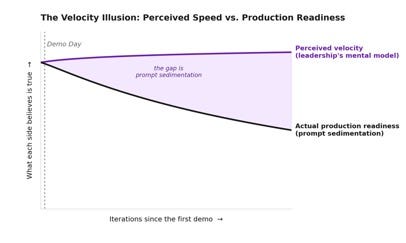
What leadership sees at Demo Day keeps climbing on belief alone. What the system can actually hold in production quietly falls behind it — the gap between the two lines is prompt sedimentation.
The accountability vacuum. When AI-generated code fails in production — and 81% of enterprise technology leaders report exactly that — the question of who is accountable produces a conversation most organizations are not equipped to have. The tool generated the code, the developer accepted it, the team shipped it, the manager approved the timeline, the executive signed the commitment that made the timeline non-negotiable. Accountability is distributed across a chain of reasonable-seeming decisions in a way that makes it effectively unlocatable. What is new is the speed at which this compounds. Traditional software failures took months or years to surface. AI-assisted projects can reach the same failure state in weeks.
The expertise inversion. If building software is as simple as writing a prompt, the scarce resource is assumed to no longer be engineering judgment but prompt-writing skill — perceived as broadly accessible and rapidly learnable. GitClear’s January 2026 analysis found that the worst code quality outcomes were nine times more likely among the heaviest AI coding tool users, not because those users lacked skill but because the tools were substituting for engineering judgment rather than amplifying it. The expertise AI tools most effectively replace is the ability to write boilerplate. The expertise they most conspicuously cannot replace — architectural judgment, security reasoning, failure mode anticipation — is precisely what determines whether a system holds in production. Organizations that reduce investment in deep technical expertise on the strength of the one-prompt illusion are making an architectural decision that will surface its consequences in a production incident, not a headcount report.
The customer consequence. This is the dynamic that matters most, because the enterprise cannot absorb it internally. An organization that ships a prototype at production scale is making an implicit promise to its customers and regulators that it is breaking before the contract ink is dry. An application that cannot handle real load fails its users. One without a security model exposes customer data. One without an audit trail cannot demonstrate compliance on demand. These are not theoretical risks — they are the operational realities that surface the moment a system built for demonstration meets the volume and adversarial conditions of a live enterprise environment.
The planning and budgeting illusion. This is the dynamic that does the most damage before a single line of code is written. When a business leader absorbs the one-prompt narrative and commissions an initiative against it, the budget and timeline that follow are not estimates — they are expressions of belief, propagating through the planning process with the force of conviction rather than the discipline of analysis. Vendors who challenge the belief are seen as less capable, not more credible. Procurement becomes a filter that selects for suppliers who confirm the expectation and against suppliers with the experience to question it. When the delivery crisis arrives, it gets attributed to execution failure rather than planning failure — and the organization concludes not that its planning assumption was wrong, but that AI-enabled delivery cannot be trusted. Forrester is predicting that 25% of planned 2026 AI spending will be deferred to 2027 as CFOs push back on projects that cannot demonstrate measurable returns. That deferral is not evidence that AI fails to deliver value. It is evidence that business cases built on prototype economics are not surviving contact with production reality.
The enterprises that break this cycle are not the ones with more conservative boards or smaller ambitions. They are the ones with enough architectural literacy at the leadership level to build business cases against production economics rather than prototype economics — and enough organizational integrity in vendor selection to reward honesty over enthusiasm.
The Structural Answer
The five dynamics above are not independent failures. They are symptoms of a single underlying condition: enterprises deploying AI-assisted development without the architectural discipline and governance structures that make AI-enabled delivery trustworthy at scale. That condition is not permanent or mysterious. It has a structural answer — though the answer is not a better tool or a more enthusiastic adoption mandate. It is a set of organizational commitments most enterprises have not yet made.
The first is distinguishing clearly, at every stage of a program, between what has been demonstrated and what has been delivered. The conflation of prototype and product is enabled as often by technical leaders who let the demo carry more weight than it should as by non-technical leaders who misread it. A shared vocabulary — proof of concept versus production readiness, with explicit criteria for crossing that boundary — is the single most effective intervention available.
The second is treating AI-assisted development as a discipline with its own governance requirements, not a productivity tool adopted without structural change. The CloudBees finding — 81% reporting more production issues, 92% confident shipping anyway — is a governance problem, not a technology problem. The tools are producing output faster than the organization’s quality and security infrastructure can evaluate it. Closing that gap requires investment in the verification layer between generation and deployment, treated as non-negotiable rather than optional.
The third is building planning and business case discipline that reflects production economics rather than prototype economics — business leaders informed enough to ask the right questions before a timeline is committed, technology leaders willing to have the uncomfortable commercial conversation rather than absorb an impossible mandate in silence, and procurement processes that reward architectural honesty overconfident misrepresentation.
The fourth is a different relationship between human judgment and AI output at every layer of delivery. The enterprises navigating this well have not eliminated human review — they have redesigned where judgment is applied: not to every line of generated code, but to the architectural decisions, the security posture, and the production readiness of what has been generated.
These four commitments share a common thread. They are not primarily about technology. They are about how an organization governs the relationship between the speed AI makes possible and the quality enterprise deployment requires. That governance gap is the defining challenge of enterprise AI adoption in 2026, and it will not be resolved by the next model release.
It is also, at its core, the same structural absence that makes enterprise agentic AI ungovernable at scale — the prototype-product gap and prompt sedimentation are the application-layer expression of a problem that recurs, in a different form, at every layer of enterprise AI deployment. The answer, in both cases, is the same in its essence.
Architecture before autonomy, governance before scale, and the discipline to treat the distance between a demo and a deployment as the most important distance in enterprise technology today.
That larger architecture — what it requires, and what most enterprises are missing — is a conversation this series will return to.
For now, the more immediate obligation sits in every boardroom, every commercial conversation, and every planning cycle where the one-prompt illusion is being allowed to set the terms of engagement.
That obligation is heaviest exactly where it is least discussed: in the commercial conversation that happens before an engineering team is ever in the room. A delivery timeline, in most organizations, is no longer a technical estimate that engineering hands up to leadership. It is a number generated in a sales conversation, informed by a demo, defended in a negotiation, and then handed down to engineering as a constraint rather than a question. By the time anyone with architectural judgment sees the commitment, it has already been signed, priced, and communicated to the customer as a promise. Fixing delivery practice without fixing that conversation does not solve the problem. It relocates the failure downstream, from a missed sprint that a team can absorb quietly to a breached contract that a customer, a board, or a regulator cannot.
This is why the prototype-product gap is, underneath the engineering language, a sales-and-procurement problem wearing a technical disguise. The organizations that avoid the worst of this are not the ones that write better prompts or run more code review. They are the ones that put an engineering voice in the room before the number is quoted, not after it is signed — because the myth is never corrected by a faster sprint. It is corrected by a harder conversation with the customer, held early, when the cost of honesty is an uncomfortable meeting rather than a broken commitment. Every vendor, consultancy, and internal platform team that lets a commercial timeline get ahead of an architectural assessment is not being helpful. It is being the mechanism by which the myth becomes someone else’s emergency.
The question is not whether AI has changed how software gets built. It has, materially and irreversibly. The question is whether the organizations commissioning that software have updated their understanding of what building it actually requires — and whether the people responsible for delivering it have the standing, the language, and the organizational support to tell the truth about what it takes, early enough for that truth to still be cheap.
Most do not. Yet. That is the gap this piece has tried to name.